
How Much Does a Painter Website Cost in Perth? (2026 Pricing Guide)
Written by the Sclouta team. Published 21 August 2026.
A painter website in Perth typically costs anywhere from a few hundred dollars for a basic DIY or freelancer setup, up to several thousand dollars for a fully custom small agency build. The number on its own doesn’t tell you much, what matters is what’s actually included at that price: the design quality, whether SEO is set up properly, who writes the copy, whether your project photos are used well, and what happens after the site goes live.
This guide breaks down real pricing bands for Perth businesses, what drives the cost up or down, and where a painter should realistically land depending on the size and goals of their business.
Painter Website Cost in Perth: 2026 Price Ranges
| Option | Typical Cost | What You're Really Paying For |
|---|---|---|
| DIY builder (Wix, Squarespace, GoDaddy) | $0–$500/year | Your own time, a template and an ongoing monthly subscription |
| Local freelancer | $1,500–$2,500+ | A one-off custom build with variable ongoing support |
| Small local agency | $3,000–$7,000+ | Custom design, on-page SEO setup, revisions and support |
| Larger creative agency | $10,000+ | Bespoke branding, extensive strategy work and a larger project scope |
| Sclouta DONE-FOR-YOU | $300–$850 | Purpose-built painter website, SEO foundations and no subscription |
These ranges are indicative rather than fixed market rates. Website pricing varies considerably by provider, scope and what’s included in the build.
A few things stand out once you line these up side by side. For a small painting business, that gap can make it difficult to know whether you’re getting a genuinely better website or simply paying for a larger agency process. You either end up with a generic template you built yourself at 10pm, or you’re quoted thousands of dollars for a scope that’s built for a much bigger business than yours.
That gap is worth understanding before you commit to anything.
Which Painter Website Option Makes Sense?
DIY: Best if budget is extremely limited and you have time to build and maintain the site yourself.
Freelancer: Useful when you want a more customised site without agency-level pricing.
Agency: Makes more sense when you need broader strategy, branding, SEO or a larger website.
Done-for-you fixed-price: Useful when you want a professional site without committing to a large custom project or ongoing subscription.
Why Painter Website Prices Vary So Much
If you’ve asked around, you’ve probably had wildly different answers, one quote for $200, another for $4,000, for what sounds like “the same thing.” It’s not that anyone is overcharging or lying. It’s that “a website” isn’t one product. It’s a bundle of very different things depending on who builds it.
DIY builders put the labour back on you. You’re paying a small monthly fee for a platform, but you’re the one choosing templates, writing every page, sourcing images, and figuring out SEO settings you’ve probably never heard of. For a painter who’s already stretched managing jobs, quotes, and staff, that time cost is real, even if the dollar figure looks small.
If you’d rather have the work handled for you, a done-for-you website service shifts the design, copy and setup work back to the provider.
Freelancers usually charge less than agencies because they’re one person without the overheads of a team. That can mean good value, but you’re more dependent on one person’s skills, availability and capacity for support after launch.
Small agencies charge more because you’re paying for a team: someone designs, someone builds, someone (hopefully) handles SEO properly, and there’s usually a support process if something breaks. The trade-off is cost and, sometimes, a longer timeline.
Subscription-based “free” website offers are worth a specific mention, because they’re common in the trades space. A provider builds your site for little or nothing upfront, then locks you into a monthly fee, often $100–$300+ a month, indefinitely. Over two or three years, that “free” website can end up costing far more than a one-time build, and if you ever stop paying, the site usually disappears.
None of these models is automatically wrong. The right one depends on your budget, how much time you have, and how long you plan to run the business.
If budget is your main concern, compare the cost of a DIY setup with a affordable website packages rather than looking only at the upfront price.
Why Painter Website Prices Vary So Much
If you’ve asked around, you’ve probably had wildly different answers, one quote for $200, another for $4,000, for what sounds like “the same thing.” It’s not that anyone is overcharging or lying. It’s that “a website” isn’t one product. It’s a bundle of very different things depending on who builds it.
DIY builders put the labour back on you. You’re paying a small monthly fee for a platform, but you’re the one choosing templates, writing every page, sourcing images, and figuring out SEO settings you’ve probably never heard of. For a painter who’s already stretched managing jobs, quotes, and staff, that time cost is real, even if the dollar figure looks small.
If you’d rather have the work handled for you, a done-for-you website service shifts the design, copy and setup work back to the provider.
Freelancers usually charge less than agencies because they’re one person without the overheads of a team. That can mean good value, but you’re more dependent on one person’s skills, availability and capacity for support after launch.
Small agencies charge more because you’re paying for a team: someone designs, someone builds, someone (hopefully) handles SEO properly, and there’s usually a support process if something breaks. The trade-off is cost and, sometimes, a longer timeline.
Subscription-based “free” website offers are worth a specific mention, because they’re common in the trades space. A provider builds your site for little or nothing upfront, then locks you into a monthly fee, often $100–$300+ a month, indefinitely. Over two or three years, that “free” website can end up costing far more than a one-time build, and if you ever stop paying, the site usually disappears.
None of these models is automatically wrong. The right one depends on your budget, how much time you have, and how long you plan to run the business.
If budget is your main concern, compare the cost of a DIY setup with a affordable website packages rather than looking only at the upfront price.

What Actually Drives the Cost of a Painter Website
Once you understand the model (DIY, freelancer, agency), the next layer is what’s actually included in the price. This is where two quotes with similar numbers can represent very different value.
Design work. A custom design built around your business, your services, your project photos, your service areas, takes more time than customising an off-the-shelf template. That time is reflected in the price.
Copywriting. Someone has to write your homepage, service pages, and about section in a way that actually reads well and explains what you do. If a provider is writing that content for you, that’s a meaningful part of the cost. If you’re expected to supply it yourself, the price should reflect that.
SEO setup. This is one of the most misunderstood cost drivers. “SEO included” can mean a properly structured site with page titles, meta descriptions, schema markup and a sitemap, or it can mean nothing more than a default plugin left untouched. Ask what it actually includes.
Photography and project galleries. For a painter, your before-and-after work is one of the most persuasive things on the entire site. If a provider is helping you present that well, proper image sizing, layout, captions, that takes more effort than dropping in a stock photo gallery.
Technical setup. Hosting, domain connection, SSL security, contact forms, mobile responsiveness, these are often assumed to be “just part of it,” but they all take time to configure correctly, and they’re often where corners get cut on cheaper builds.
Ongoing support. Some providers disappear after handover. Others offer a support window, or ongoing access to make changes. That difference matters more than most people expect until they need to update a phone number six months later and can’t get in touch with whoever built the site.
How to Compare Painter Website Quotes
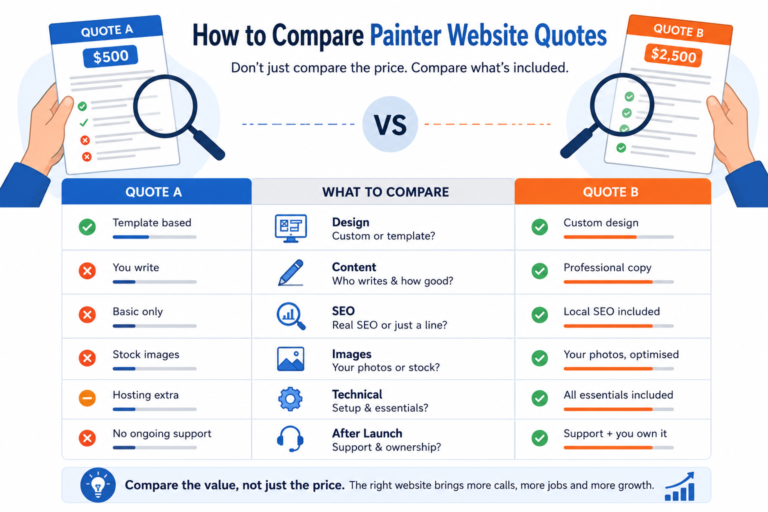
This is often the part that trips people up. If you’re holding two quotes, one for $500 and one for $2,500, the price gap alone doesn’t tell you which is the better deal. Compare what’s actually inside each one.
Design Is it a custom layout, or a generic template with your logo dropped in? Is it genuinely mobile-friendly, not just “technically responsive”?
Content Who’s writing the words on the page, you, or the provider? Are your services and project examples actually described, or is it filler text?
SEO Are page titles and meta descriptions set up properly? Is there a local SEO structure for the suburbs you work in? Or is “SEO included” just a line item with nothing behind it?
Images Are your project photos being used and optimised properly, or are you getting stock imagery that could belong to any painting business in Australia?
Technical foundations Is hosting included or separate? Is there an SSL certificate? Are contact forms and click-to-call functionality actually set up and tested?
After launch What happens once the site goes live? Are revisions included? Is there ongoing support, or are you on your own from day one? And critically, is there a subscription lock-in, or do you own the site outright?
Running through this list against any quote you receive will tell you far more than the number at the bottom of the page.
Sclouta's Painter Website Packages
Sclouta builds done-for-you websites for Perth painters and other local trades, with three fixed, one-time pricing tiers. The main difference between the packages is how much website scope, local SEO and service-area targeting you need.
$300 — Basic
Best for a new painting business that needs to get online quickly without a complex website.
- 5-page website
- Domain and hosting setup
- On-page SEO
- Google indexing submission
- Live in 24 hours
$490 — Growth
Best for a Perth painting business that wants a stronger foundation for local search and more room to target individual services.
- Everything in Basic
- Additional service pages
- Google Business Profile setup
- Local SEO configuration
- Suburb keyword targeting
$850 — Premium
Best for established painting businesses competing across multiple Perth suburbs.
- Everything in Growth
- Full local SEO structure
- Suburb pages for targeted Perth areas
- 30-day post-launch support
All three packages are one-time costs with no ongoing website subscription. The right option depends less on how many features you can get and more on how much service and local-search coverage your business actually needs.
Hidden Costs to Watch For
A cheap quote can quietly become an expensive website once you factor in what wasn’t mentioned upfront. Before you sign anything, check for these:
Domain ownership — Is the domain registered in your name, or does the provider hold it? If they hold it, you don’t fully control your own web address.
Hosting — Is it included in the price, or billed separately as an ongoing cost?
Maintenance fees — Some providers charge monthly “maintenance,” even for a site that rarely needs touching.
Future edits — Are small changes (updating a phone number, adding a new service) included, or charged individually every time?
Content responsibility — Does the provider write your copy, or is that on you? If it’s on you, factor in that time.
Image supply — Are your own project photos being used, or is it generic stock photography?
SEO included — Ask specifically what this means. Basic metadata is not the same as a properly structured, locally optimised site.
Lock-in — Can you leave and take your website with you if you’re not happy, or are you tied into an ongoing contract?
That last point matters more than it might seem. A website that looks affordable today but locks you into years of payments, or that you can’t move if the relationship sours, often ends up costing more than a straightforward one-time build.
Is a Professional Painter Website Worth It?
It’s a fair question, especially when a Facebook page or a Google Business Profile alone can feel like enough.
The honest answer is that a website won’t guarantee a fixed number of jobs, and any provider who promises it “pays for itself” with a specific dollar figure is oversimplifying something that isn’t that predictable. What a well-built website does provide is a set of real, practical advantages:
- A more credible first impression when someone finds you through a referral, a Google search, or a Facebook post and wants to check you out before calling.
- A straightforward way for someone to get in touch, instead of relying entirely on messaging you through social media.
- Better visibility in local Perth searches over time, when SEO foundations are actually set up properly.
- A place to showcase completed projects properly, rather than a scattered photo album on a social feed.
- Fewer missed opportunities from people who simply move on to the next painter in the search results if they can’t find you at all.
For a painter who’s relying purely on word-of-mouth and social media, a website isn’t about replacing what’s working, it’s about giving people a reliable place to land when word-of-mouth sends them looking for you online.
How Sclouta Builds Websites for Perth Painters
Sclouta is a Perth-based agency that builds done-for-you websites for painters and other local trades, without the subscription lock-in that’s become common in this space. Fixed, one-time pricing across three tiers means you know exactly what you’re paying upfront, with no ongoing surprises.
If you’re comparing website quotes and want a site built specifically for a painting business, see Sclouta’s painter website design service to compare what’s included and which package may fit your business.