
What Should an Electrician Website Include?
Written by the Sclouta team. Published 17 August 2026.
An electrician’s website has one job before anything else: give a potential customer enough confidence to make contact.
Someone searching for an electrician isn’t looking for a clever design experiment. They want to know what you do, whether you work in their area, whether you’re properly qualified, what other customers think of you, and how quickly they can reach you.
That means a good electrician website needs more than a logo, a list of services and a contact page. It needs to remove uncertainty.
Here’s the checklist I’d use to evaluate one.
Electrician Website Checklist
At a minimum, a professional electrician website should include:
- Clear information about the electrical services offered
- A homepage that explains what the business does and where it works
- Relevant licence and credential information
- Individual pages for important services
- A clearly defined service area
- Genuine project photos
- Customer reviews and testimonials
- A simple way to call or enquire
- Mobile-friendly design
- Fast, easy-to-use pages
- Clear business and contact information
- Local SEO foundations
- An About page that establishes who is behind the business
- Straightforward information about what customers can expect
Here’s why each one matters.
1. A Homepage That Gets to the Point
Your homepage shouldn’t make visitors work to understand the business.
Within a few seconds, someone should be able to answer three questions:
- What do you do?
- Where do you work?
- How can I contact you?
For example, an electrician might clearly state that they provide residential and commercial electrical services across Perth, followed by a prominent phone number or enquiry button.
Don’t hide the important information behind sliders, oversized animations or long introductions.
A strong homepage gives visitors the essentials first, then lets them explore the details.
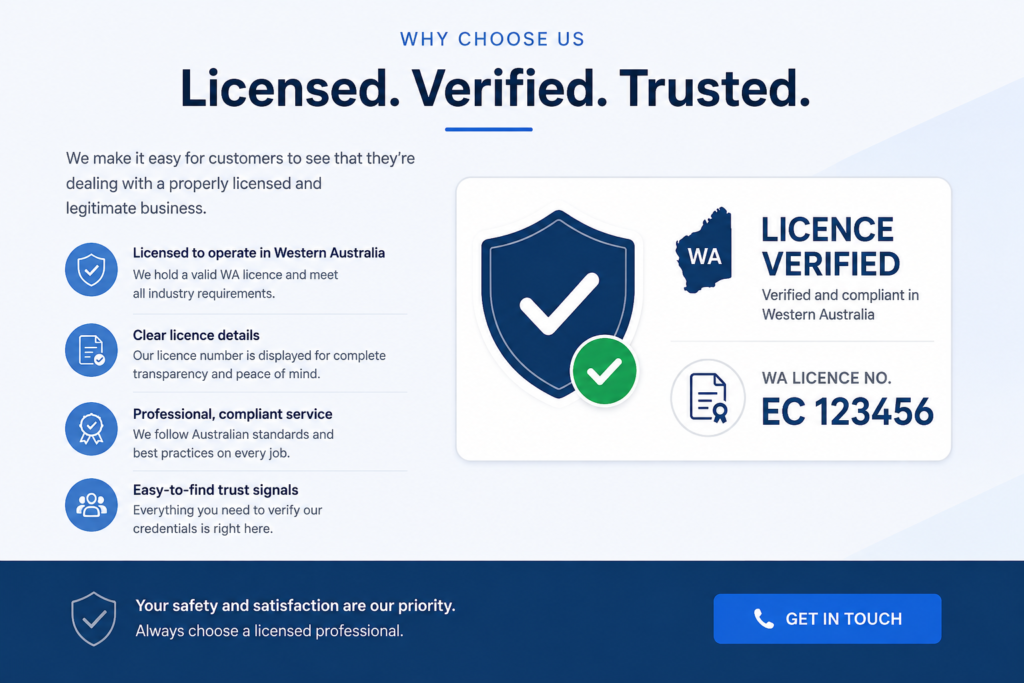
2. Licence and Credentials That Customers Can Verify
Electrical work is a trust-sensitive service. Customers want to know they’re dealing with a legitimate, properly licensed business.
If you operate in Western Australia, make relevant licensing information easy to find and give customers a clear way to verify it through the appropriate authority. In Western Australia, customers can use the WA Government licence search to check relevant licence and registration information.
Don’t bury important credentials in tiny footer text. Put them somewhere customers will actually see them, such as the footer, About page or contact section.
The same principle applies to other genuine credentials, qualifications, memberships and insurance information. Only display credentials that actually apply to the business.
Trust works best when customers can verify it rather than simply being told to trust you.
3. Clear Service Pages (Not Just a Service List)
A list such as:
Switchboards | Lighting | EV Chargers | Fault Finding | Solar
tells visitors what you offer, but it doesn’t necessarily answer their questions.
Important services deserve enough information to explain:
- What the service involves
- What problems it solves
- Who typically needs it
- What the process involves
- What the customer should do next
For a larger electrician website, this may mean giving important services their own pages. The number of pages and services you need can also affect the overall project scope, so it’s worth understanding how much an electrician website costs in Perth before deciding what to include.
For example:
- Switchboard upgrades
- Emergency electrical services
- Residential electrical work
- Commercial electrical services
- Lighting installation
- EV charger installation
Don’t create a separate page simply because you can. A service deserves its own page when customers search for it independently or when it needs enough information to properly answer their questions.
4. A Visible, Specific Service Area
Tell visitors exactly where you work.
“We service Perth” may be accurate, but it doesn’t tell someone in Joondalup, Rockingham or Canning Vale whether you actually take jobs in their area.
If you genuinely service particular suburbs or regions, make that information easy to find.
It also provides useful local context for search engines.
But avoid turning your website into a giant list of suburbs purely for SEO. Don’t claim areas you don’t genuinely service.
Accurate location information is more useful than keyword-filled location pages.
5. Real Project Photos, Not Stock Images
Stock photos can make one electrician’s website look almost identical to another’s.
Real project photos are different.
Show the work you’ve actually completed:
- Switchboard upgrades
- Lighting installations
- Renovation work
- Commercial fit-outs
- EV charger installations
- Completed electrical projects
Good project photography doesn’t need to look like a magazine shoot. It needs to be genuine, clear and relevant. If you’re looking for ideas on how electrical businesses can present their work online, these electrician website examples are a useful place to start.
If you don’t have a library of photos yet, start taking a few useful images after suitable jobs, with the customer’s permission where necessary.
And don’t use generated or stock images to imply that a project was completed by your business when it wasn’t.
6. Reviews and Testimonials Where People Actually Look
Reviews help answer a question your website copy can’t answer on its own:
“What was it actually like dealing with this business?”
If you have genuine customer reviews, consider displaying selected feedback near important decision points such as the homepage, service sections or enquiry form.
You don’t necessarily need a huge testimonials page.
A relevant review beside the service a customer is considering can be more useful than making them navigate somewhere else to find it.
Keep reviews genuine and identifiable. Don’t manufacture testimonials or rewrite customer feedback to make it sound better.
7. A Simple, Fast Way to Get in Touch
A visitor shouldn’t have to hunt for your phone number.
Make contacting the business easy:
- Use a clickable phone number on mobile
- Put the phone number somewhere prominent
- Keep enquiry forms short
- Ask only for information you actually need
- Include the business’s email and other relevant contact details
- Make the next step obvious
For a simple enquiry form, you may only need the customer’s name, contact details, suburb and a short description of the job.
The principle is straightforward:
The easier it is to contact you, the less work the customer has to do before becoming a lead.
8. A Website That Works Properly on a Phone
People searching for an electrician may be using their phone while dealing with an urgent problem, comparing quotes or looking for someone who services their suburb.
If the website is difficult to use on a small screen, that creates unnecessary friction.
Check that:
- Text is easy to read
- Buttons are easy to tap
- Phone numbers are clickable
- Forms work properly
- Images don’t slow the page unnecessarily
- Important information isn’t hidden on mobile
Mobile usability isn’t just a design preference. It affects whether a visitor can actually use the website when they need it.
9. Basic Local SEO Foundations
A good electrician website should make three things clear:
who you are, what you do and where you work.
That starts with fundamentals such as:
- Descriptive page titles
- Clear service pages
- Relevant location information
- Consistent business details
- Useful internal links
- A properly managed Google Business Profile
- Mobile-friendly pages
- Fast loading times
- Content written around real customer questions
Local SEO isn’t about repeating “electrician Perth” in every paragraph.
It’s about making the business, its services and its service area clear enough for both customers and search engines to understand.
For electricians relying on local searches, Google Maps visibility is another important part of being found by nearby customers.
10. An About Page That Shows Who Is Behind the Business
People are often inviting an electrician into their home, workplace or investment property.
So tell them who they’re dealing with.
A useful About page can include:
- The business owner
- Team members
- Experience
- Qualifications
- Areas served
- Types of electrical work undertaken
- Relevant credentials
- Genuine team photographs
Avoid turning the page into a long autobiography.
The goal is simple: help a potential customer understand who they are considering hiring and why the business is qualified to do the work.
11. Honest Information About What Customers Can Expect
A website becomes more useful when it answers questions before customers have to ask them.
Depending on the business, that might include:
- Do you provide emergency services?
- What areas do you cover?
- What types of jobs do you take?
- What are your usual response times?
- Do you work with homeowners or commercial customers?
- Do you provide written quotes?
- What happens after someone submits an enquiry?
Don’t promise something simply because it sounds good.
If you offer emergency service, say so.
If you don’t, don’t imply that you do.
If response times vary, explain that rather than making an unrealistic promise.
Straightforward information builds more trust than exaggerated marketing claims.
What Makes an Electrician Website Effective?
The best electrician websites aren’t necessarily the ones with the most animations, pages or impressive-looking graphics.
They’re the ones that make the customer’s decision easier.
A visitor should be able to quickly understand:
- What does this electrician do?
- Do they work in my area?
- Are they legitimate and qualified?
- Can I see evidence of their work?
- Do other customers trust them?
- How do I contact them?
If the website answers those questions clearly, it is doing the job it was built to do.
The Bottom Line
A good electrician website should make the customer’s decision easier.
Visitors should quickly understand what you do, where you work, why they can trust you and how to get in touch. Clear service information, genuine proof of your work, visible credentials and a mobile-friendly experience matter far more than flashy design.
If you’re reviewing an existing website, you may not need to rebuild everything. Start by fixing the areas that create the most friction, unclear services, weak trust signals, difficult navigation or a poor mobile experience.
If you’re considering a new website, our electrician website design in Perth page explains how we approach websites for Perth electricians.