
10 Carpenter Website Features That Turn Visitors Into Quote Requests
Written by the Sclouta team. Published 11 August 2026.
If you’re a carpenter in Perth, chances are your best jobs still come from word of mouth. But word of mouth only takes a business so far, and more homeowners are starting their search on Google before they ever ask a mate for a recommendation. If your website isn’t built to capture that search, you’re relying on referrals to do all the heavy lifting.
The problem isn’t that carpenters don’t have websites. Most do. The problem is that a lot of those websites are outdated, slow, or built years ago on a template that was never designed with lead generation in mind. A carpenter website shouldn’t just show your work; it should make it easy for the right visitor to understand your services, trust your workmanship, and request a quote.
Here’s what that actually looks like in practice.
Why Most Carpenter Websites Don't Generate Enquiries
Before getting into the features, it’s worth understanding why so many carpentry websites underperform in the first place.
Common issues include:
- The homepage talks generally about “quality workmanship” without saying what services are actually offered
- Photos are low resolution, watermarked, or borrowed stock images instead of real project photos
- The site takes too long to load on mobile, and most visitors are checking from their phone
- There’s no clear next step, no obvious way to request a quote or get in touch
- The site was never updated after suburbs, services, or contact details changed
None of these are complicated fixes. They’re just details that get missed when a website is treated as a one-off task instead of an ongoing part of the business.
10 Features Every Carpenter Website Needs
1. A Homepage That Says What You Actually Build
A visitor should be able to land on your homepage and immediately understand what you do — decking, framing, custom joinery, renovations, or general carpentry — without scrolling through vague statements first. Specificity builds trust faster than generic language ever will.
2. A Fast-Loading, Mobile-First Layout
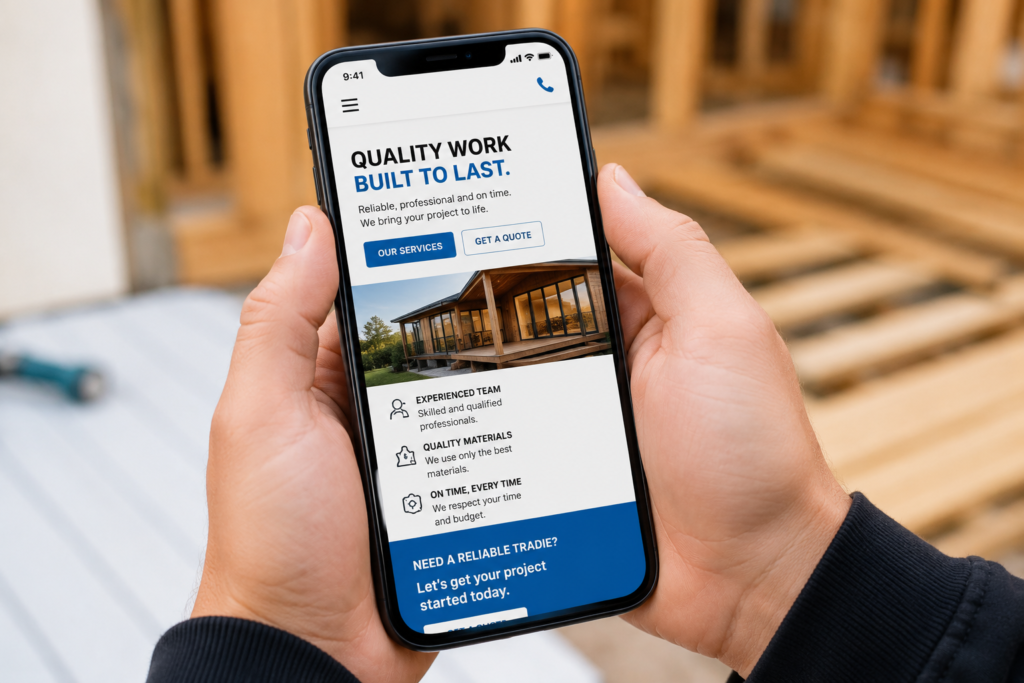
Most people searching for a carpenter are doing it on their phone, often while standing in the room they want renovated. If your site is slow to load or hard to navigate on a small screen, they’ll leave before they even see your work. A mobile-first layout isn’t optional anymore, it’s the baseline. This is one of the foundations of a well-built SEO website.
3. A Project Portfolio That Shows the Work You Want More Of
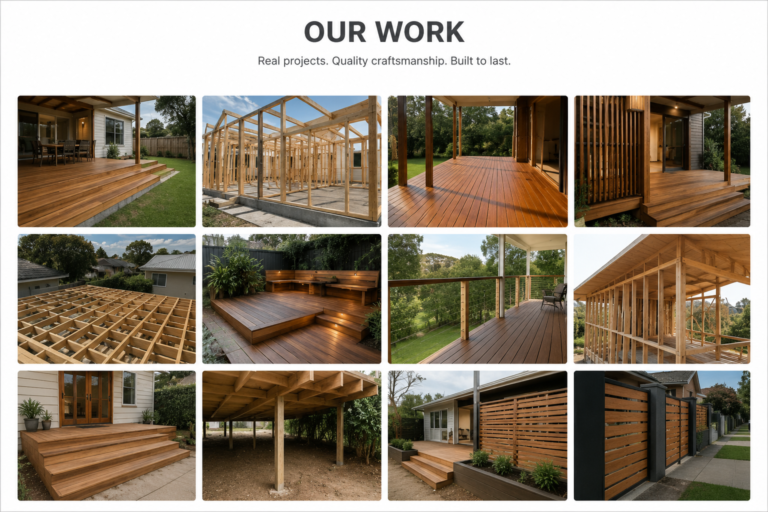
Carpentry is a visual trade, and homeowners judge your skill almost entirely on what they can see. But a portfolio isn’t just about proving you can build, it’s about steering the kind of enquiries you get. If you want more decking jobs, your portfolio needs to be full of decking. If you’d rather move away from small repairs and toward renovations or custom joinery, showing that work (not just any work) is what attracts it. A well-organised, honest portfolio, even a small one, does more to build credibility than paragraphs of text ever could.
4. Separate Pages for the Carpentry Jobs You Want More Of
Rather than one page vaguely listing “carpentry services,” break your offering into its own pages — decking, framing, renovations, extensions, custom carpentry, repairs. This does two things at once: it gives visitors instant clarity on whether you do what they need, and it gives Google a clearer signal about what each part of your site actually specialises in, which helps that page show up for the right searches.
5. Clear Service Areas So You Attract the Right Local Jobs
If you only work within a certain part of Perth, make that clear on your site. Perth is a large, spread-out metro area, and travel time matters to both you and your customer — a job an hour outside your usual radius often isn’t worth taking, even if it’s a good one. Stating your service areas plainly, rather than leaving it vague, helps the right local customers find you and cuts down on enquiries from outside your patch.
6. Trust Signals Above the Fold
Licensing details, years in the trade, insurance information, and genuine reviews should be visible early, not buried at the bottom of the page. Homeowners are inviting a tradesperson into their home, so trust signals reduce hesitation before they even reach your contact form.
7. A Quote Form That Filters Out Poor-Fit Enquiries
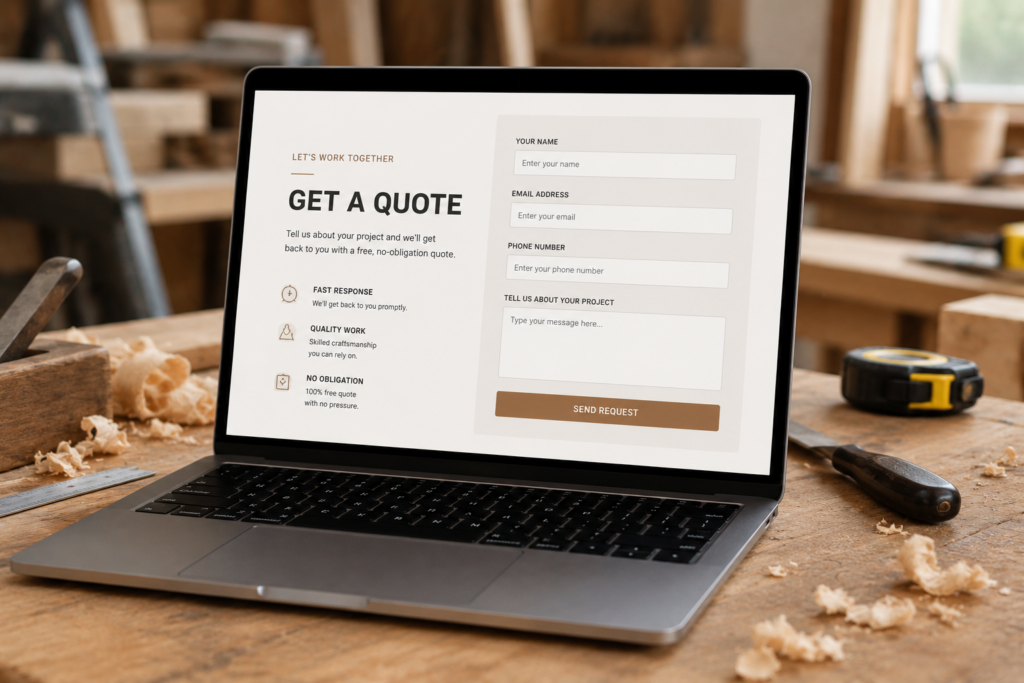
A basic “Contact Us” form invites vague, hard-to-quote messages that take several back-and-forth emails just to understand. A slightly more structured form does the filtering for you before the enquiry even lands in your inbox. A handful of well-chosen fields makes the difference:
- What type of carpentry work is it (decking, framing, renovation, repair)?
- What suburb is the job in?
- Roughly what’s the scope, a small fix or a full project?
- An optional field to upload a photo of the space or job
None of this needs to feel like a long, corporate form. Even three or four targeted questions give you enough to know whether a job is worth a callback before you’ve spent any time on it.
7. A Quote Form That Filters Out Poor-Fit Enquiries
A basic “Contact Us” form invites vague, hard-to-quote messages that take several back-and-forth emails just to understand. A slightly more structured form does the filtering for you before the enquiry even lands in your inbox. A handful of well-chosen fields makes the difference:
- What type of carpentry work is it (decking, framing, renovation, repair)?
- What suburb is the job in?
- Roughly what’s the scope, a small fix or a full project?
- An optional field to upload a photo of the space or job
None of this needs to feel like a long, corporate form. Even three or four targeted questions give you enough to know whether a job is worth a callback before you’ve spent any time on it.
8. Google Business Profile Integration
Your website and Google Business Profile should work together, not sit as two separate things. Keeping your details consistent across both, linking through to your profile, and encouraging reviews via your site all help your visibility in local map searches, often the very first thing a homeowner checks before they even open a website.
9. Simple, Honest Pricing Information
You don’t need to publish exact quotes, but giving visitors a general sense of how pricing works — what affects cost and what a typical project range looks like — removes a major point of hesitation. People are far more likely to enquire when they’re not worried about being blindsided.
10. A Clear, Low-Pressure Call to Action
Every page should make it obvious what to do next, call, message, or request a quote, without feeling pushy. A calm, direct call to action consistently outperforms an aggressive sales pitch, especially in a trade where trust matters more than urgency.
What a Lead-Focused Carpenter Website Does Differently
| Website Element | Basic Website | Lead-Focused Carpenter Website |
|---|---|---|
| Homepage | General introduction | Clear services with a strong quote CTA |
| Portfolio | A few random project photos | Projects organised by carpentry service |
| Services | One generic services page | Dedicated pages for key carpentry services |
| Service Areas | “Serving Perth” | Clear suburbs and areas serviced |
| Quote Form | Name, email and message | Job type, suburb and project details |
| Trust | Basic testimonials | Reviews, credentials and real project proof |
| Mobile Experience | Responsive but not always optimised | Fast, mobile-first and easy to contact |
| Call to Action | “Contact Us” | “Request a Quote” or “Discuss Your Project” |
| Pricing Information | No guidance | Clear explanation of what affects project cost |
| Google Presence | Website and Google Business Profile treated separately | Website and Google Business Profile work together |
How Much Does a Carpenter Website Cost?
Cost is another factor worth weighing up alongside these features, pricing varies depending on what’s included, and it’s worth understanding what a fair, one-time cost actually looks like versus an ongoing subscription. For a full breakdown of what’s included in each package, see our to website design costs in perth.
Getting Your Carpentry Business Found Online
If your carpenter website isn’t doing these things, it may be time for a better approach. A lead-focused website can help you showcase the right work, build trust with local visitors, and make it easier for potential customers to request a quote.